
FilmLune · création et galerie IA
Prompts sélectionnés | Créez facilement des images et vidéos IA
Comprendre FilmLune
FilmLune réunit un générateur d’images IA et une galerie d’exemples image et vidéo. Chaque fiche présente le résultat, le prompt disponible, le modèle déclaré et une méthode à adapter.
Explorer tous les promptsUne méthode lisible
Deux points d’entrée
Partez d’un exemple image pour travailler une composition fixe, ou d’un exemple vidéo pour étudier le mouvement, les entrées et la durée. Chaque bibliothèque renvoie vers les mêmes fiches canoniques.
Repères utiles
Les modèles et réglages décrivent la révision visible : FilmLune ne remplace pas silencieusement le modèle pendant le transfert. Une œuvre externe conserve son attribution et son lien source sur sa fiche.
Seulement lorsque les droits de la révision le permettent. La fiche conserve alors le prompt et sa provenance ; une action indisponible n’est pas remplacée par un faux contenu.
Non. Une version de modèle, une entrée ou un réglage peuvent modifier le rendu. Utilisez la méthode comme point de départ et vérifiez les paramètres avant de générer.
 SpringWangGPT Image 2.5
Create one 9:16 vertical image with the authentic look of a spectator’s smartphone recording, to serve as the opening frame of a circus acrobatics video. Show one complete scene.
MOST IMPORTANT — CAMERA DISTANCE AND RUN-UP SPACE:
Position the camera well back from the performers. Film from the front-to-middle section of the audience seating, using a wide, distant view that captures a substantial part of the arena.
The composition should feel like a spectator recording the overall performance, not a close-up of an individual act. Clearly establish the performer’s running approach, the elephant, the first trampoline, the second trampoline, and the horse waiting farther away.
There must be a clearly visible stretch of open sand between the woman and the first trampoline, long enough for several full running strides. She is only beginning her approach, not already arriving at the elephant or trampoline.
SETTING:
A large indoor circus arena filled with spectators. The performance area is a broad expanse of pale yellow-brown sand, surrounded by a low, dark-red ring barrier.
Behind the barrier, tiered circular audience seating rises in rows, with a mixture of red, yellow, and dark seats. Spectators wear ordinary everyday clothing. Parts of the circus roof, vertical support poles, and a ring of warm-white overhead lights are visible above.
The arena is well lit, while the audience seating is slightly darker. A faint trace of airborne dust and atmospheric haze catches the lights. Exposure should resemble an ordinary smartphone recording of an indoor performance, not cinematic lighting.
PERFORMER:
One adult female acrobat in her twenties, with a slender, athletic build and dark-brown hair neatly secured in a bun. She wears a simple, fitted, lavender long-sleeved acrobatic unitard and matching soft performance shoes.
She is positioned in the lower-left foreground area of the arena, still viewed from a distance. The elephant and the first trampoline are noticeably farther away, leaving a generous, clearly visible running approach.
She is just beginning to run diagonally toward the first trampoline in the center-right midground. Her torso leans forward slightly, one leg steps ahead while the other pushes off the ground, and her arms swing naturally. Her eyes are focused on the first trampoline.
Show her entire body. Her pose should look like a genuine instant captured during a running movement. The open distance ahead of her must immediately communicate that she is about to run across the arena before taking off.
ELEPHANT AND EQUIPMENT:
A large gray elephant with naturally wrinkled skin stands in the center-right midground. Its body is seen in a three-quarter side view, with its head turned toward the front-left, approximately facing the approaching performer.
All four feet rest naturally on the sand. Its posture is calm and steady. Its trunk extends naturally toward the first trampoline, without touching the performer. Keep the elephant at a clear distance from the camera and visibly separated from the woman’s starting position.
The FIRST TRAMPOLINE stands in the center-right midground, a short distance in front of the elephant, with natural working clearance rather than being pressed against its body. It lies directly ahead of the performer’s running approach and is her first clear destination.
It is a low, round acrobatic trampoline with a light-blue padded rim, a pale gray-beige elastic mat, and a silver-gray metal ring supported by crossed metal braces. It rests firmly on the sand.
The SECOND TRAMPOLINE is a separate, matching trampoline positioned several meters to the front-left of the first, in the center-left area of the arena. Both trampolines must be clearly distinguishable as two independent pieces of equipment.
Leave an open stretch of sand between them, establishing the space the performer will later cross through the air. Keep the woman’s initial running approach unobstructed.
A dark-brown horse with a black mane and tail is farther away in the left background, near the ring barrier. It is walking slowly and naturally, with no rider on its back.
The horse appears relatively small in the composition. It establishes the later landing target without competing with the main action.
CAMERA AND COMPOSITION:
Use a wide establishing view from the audience seating, at a slightly elevated angle looking gently down into the arena. The camera remains well back from the action.
The spatial arrangement should be immediately readable:
The woman beginning her run is in the lower-left foreground area.
The elephant and first trampoline are in the center-right midground.
The second trampoline is in the center-left midground.
The horse is farther away in the left background.
Keep generous empty space above the performers for the later airborne movements. A few softly blurred silhouettes of spectators’ heads may appear along the very bottom edge, but they must not obscure the woman, either trampoline, or the elephant.
Preserve realistic proportions, subtle smartphone noise, natural focus, and the slightly imperfect appearance of an audience-shot recording.
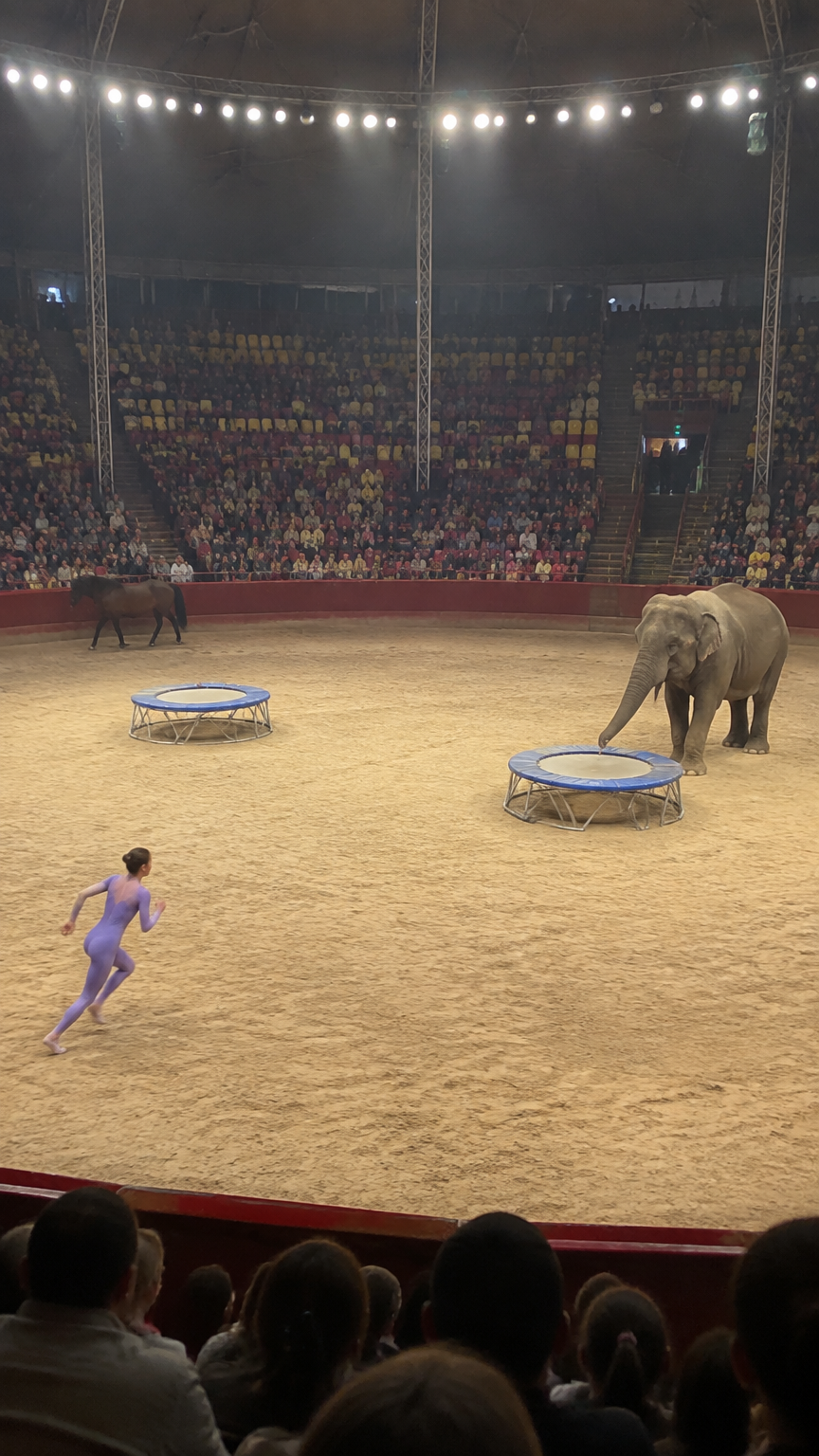
Do not include a video player interface, progress bar, playback buttons, timestamps, subtitles, logos, or watermarks.Une image verticale en 9:16 générée avec GPT Image 2.5, imitant une capture prise par un spectateur dans les gradins d'une arène de cirque. Une acrobate entame sa course diagonale sur le sable, avec un éléphant, deux trampolines distincts et un cheval disposés de façon lisible dans la profondeur de la piste.
Prompts et exemples d’imagesServir de première image d'une vidéo d'acrobaties de cirque : le cadrage large et distant doit installer tout le décor de la piste et laisser comprendre que la performance aérienne est sur le point de commencer. L'intention est le réalisme d'un enregistrement de spectateur, pas l'esthétique d'une affiche ou d'un plan cinématographique.
Composez l'image en 9:16 depuis la section avant ou médiane des gradins, en plongée légère, caméra nettement reculée. La piste est un large sablon jaune pâle cerclé d'une barrière rouge sombre, avec des gradins circulaires plus sombres derrière et des projecteurs blanc chaud sous le chapiteau, avec une légère brume et de la poussière en suspension. Placez l'acrobate en bas à gauche, tout au début de sa course diagonale : buste incliné, une jambe devant, bras en mouvement, corps entier visible, et surtout une longue étendue de sable libre entre elle et le premier trampoline. Au centre-droit du plan moyen, un éléphant gris de trois quarts, calme, pattes au sol, trompe tendue vers le premier trampoline sans la toucher. Ce trampoline, rond, à liseré bleu clair et toile gris-beige sur armature métallique, posé à distance de travail de l'éléphant. Le deuxième trampoline jumeau se situe plusieurs mètres plus à l'avant-gauche, au centre-gauche, séparé du premier par du sable ouvert. Un cheval brun foncé sans cavalier marche lentement au fond à gauche, près de la barrière, de taille réduite dans la composition. Gardez de l'espace vide au-dessus des artistes et, éventuellement, quelques silhouettes floues de têtes en bas du cadre sans jamais masquer l'action. Terminez par un rendu crédible de smartphone : exposition ordinaire, léger bruit, mise au point naturelle, imperfections discrètes, sans interface de lecture ni mention écrite d'aucune sorte.
Générée avec GPT Image 2.5 en 9:16 ; il s'agit d'une image fixe servant de plan d'ouverture, sans mouvement ni durée. Les modèles d'image traitent de façon inégale les scènes à plusieurs sujets et à géométrie contrainte : l'éléphant peut se retrouver trop près de la caméra ou des trampolines, la course peut être rendue trop avancée, ou les proportions du cheval et des gradins varier. Le rendu « smartphone » dépend de la subtilité du bruit et de l'exposition et peut virer au cinématographique ou au trop propre. Les foules lointaines et les structures de chapiteau sont souvent simplifiées ou imprécises. Il ne s'agit pas d'un vrai cirque ni de personnes réelles ; toute utilisation doit être présentée comme une image générée.