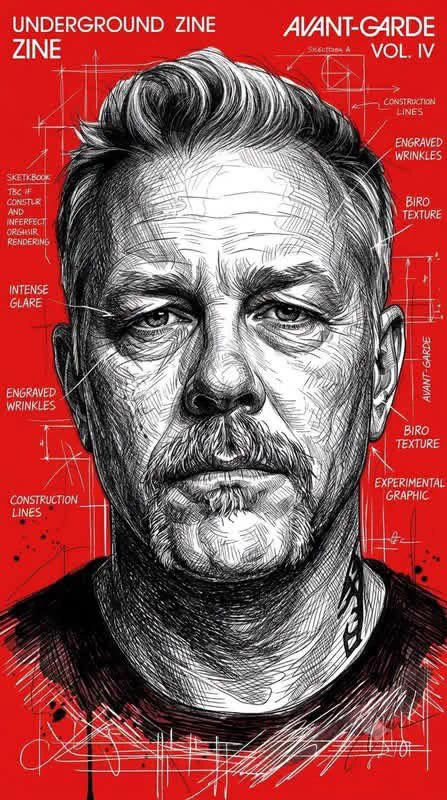
A densely hatched face dominates a red field, surrounded by white notes and technical sketchbook construction marks. Dense black hatching gives the face volume against a red field, while white marginal marks suggest a technical sketchbook page. One dominant face and a few larger words keep the fanzine hierarchy readable despite the intricate linework.
How to adapt the method
Reuse the complete prompt with Nano Banana Pro, explicitly credited by the author. It asks for a ballpoint treatment translated into black ink, dense cross-hatching and white annotations on red. Prioritise contrast and the face-heading-notes hierarchy. The recipe is self-contained and does not request a reference photograph. Preserve the suffixes as source text without presenting them as verified provider settings.
Limitations: The prompt does not specify identity or exact facial features. No real-person likeness is promised; only the source post’s second image is selected. The words, repeated ZINE and tiny notes are not controlled final copy. Proofread and correct lettering before using the result as a real cover or commercial design. The retained file is 447 × 800 pixels, close to but not exactly 9:16. It is not a high-resolution print master, and no upscaling was performed here. The --ar 9:16 and --stylize 750 suffixes are source text. Provider support for them, the seed and other execution settings are not evidenced. Review the eyes at thumbnail size, then check the small notes at full size. The prompt converts the initial blue-ballpoint idea into black ink; source suffixes and generated lettering are not verified execution settings or final print copy.
How to use this prompt
1
Read the complete prompt alongside the result. Identify the subject, framing, lighting and visual style before changing the brief.
2
Open the selected recipe in Studio with its model and starting settings. Check the available version, frame and resolution before generating; a size written in the source prompt is not an output setting or a guarantee.
3
Use the customization fields below to rewrite the brief: Lines and volume / Editorial hierarchy / Palette. Keep the composition and other constraints that make this example useful. Check the current credit quote before submitting.
What to check in your result
Compare the result with the chosen example: subject position, light direction and the balance between foreground and background. Inspect hands, faces, product shapes and any text at full size. Change one variable at a time so you can judge what improved.
Variables to customize
Lines and volume
Dense cross-hatching shapes the face, finer strokes describe contours and irregular marks add sketchbook energy.
Editorial hierarchy
One dominant face, a few larger words near the top and smaller peripheral notes; keep the eyes readable.
Palette
Black ink, vivid red field and white marks. The opening blue-ballpoint phrase is explicitly followed by conversion into black.