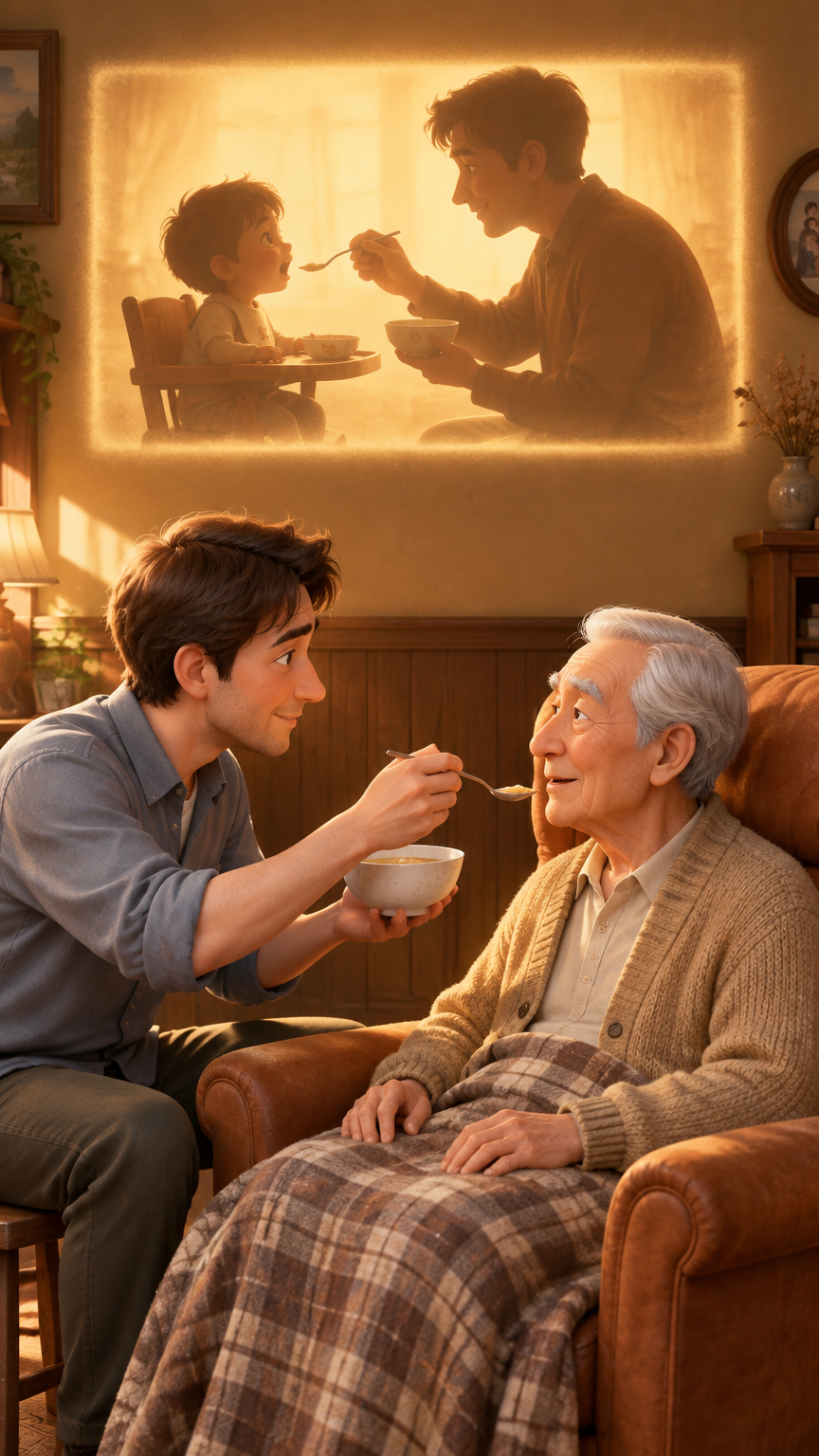
A 3D render in animated-film style shows an adult son spoon-feeding his aging father in an armchair, while a glowing wall panel recalls the reversed childhood moment when the father fed him. Vertical 9:16 framing, designed as the first frame of a family short film.
How to recreate it
1. Specify a high-quality 3D animated-film look with gently stylized features, naturally believable bodies, and a fixed eye-level medium shot. 2. Give the lower two thirds to the present: on the left, a son around thirty-two with slightly messy chestnut hair, a grey-blue shirt with rolled sleeves, seated on a small stool and leaning right, one hand steadying an off-white ceramic bowl, the other holding a spoon that stops short of his father's lips, his gaze patient with a faint smile. On the right, a father around seventy-eight with silver hair combed sideways, thick soft white eyebrows, a thin face and faint wrinkles, wearing an oatmeal knit cardigan over a light beige shirt, a grey-brown plaid blanket over his legs, hands resting on it, body tilted toward his son, calm and attentive. 3. In the upper portion, place a warm golden rectangular light panel with soft edges on the wall, holding a childhood memory in clearly readable dark warm-brown silhouette: a toddler of about three in a high chair with a small tray on the left, the young father on the right, spoon in hand, feeding the child from right to left. Keep the silhouettes fully inside the panel, never overlapped by the heads below. 4. Light the room with late-afternoon honey-gold light, a few fine dust motes, and warm translucent shadows; warm brown walls, dark wood wainscoting, a caramel high-back armchair. 5. Build the mirrored action: the son feeds left to right below, the father fed right to left above. 6. Render fine hair, skin, knit, and blanket-fold detail, keeping both layers sharp with no depth-of-field blur on the memory. 7. Forbid all text, subtitles, watermarks, player UI, and extra characters.
Limitations
The image is generated with GPT Image 2.5 in a 9:16 aspect ratio; it is a still first frame and produces no motion. 3D generators often blend the two pairs of figures, clip the memory silhouette, or drift toward a dim, overly yellow room, so several attempts are usually needed. The shared nose and profile linking the two fathers remains approximate, and no specific result is guaranteed across runs.