Yellow taxi on a rainy New York street at night — AI Image Prompt
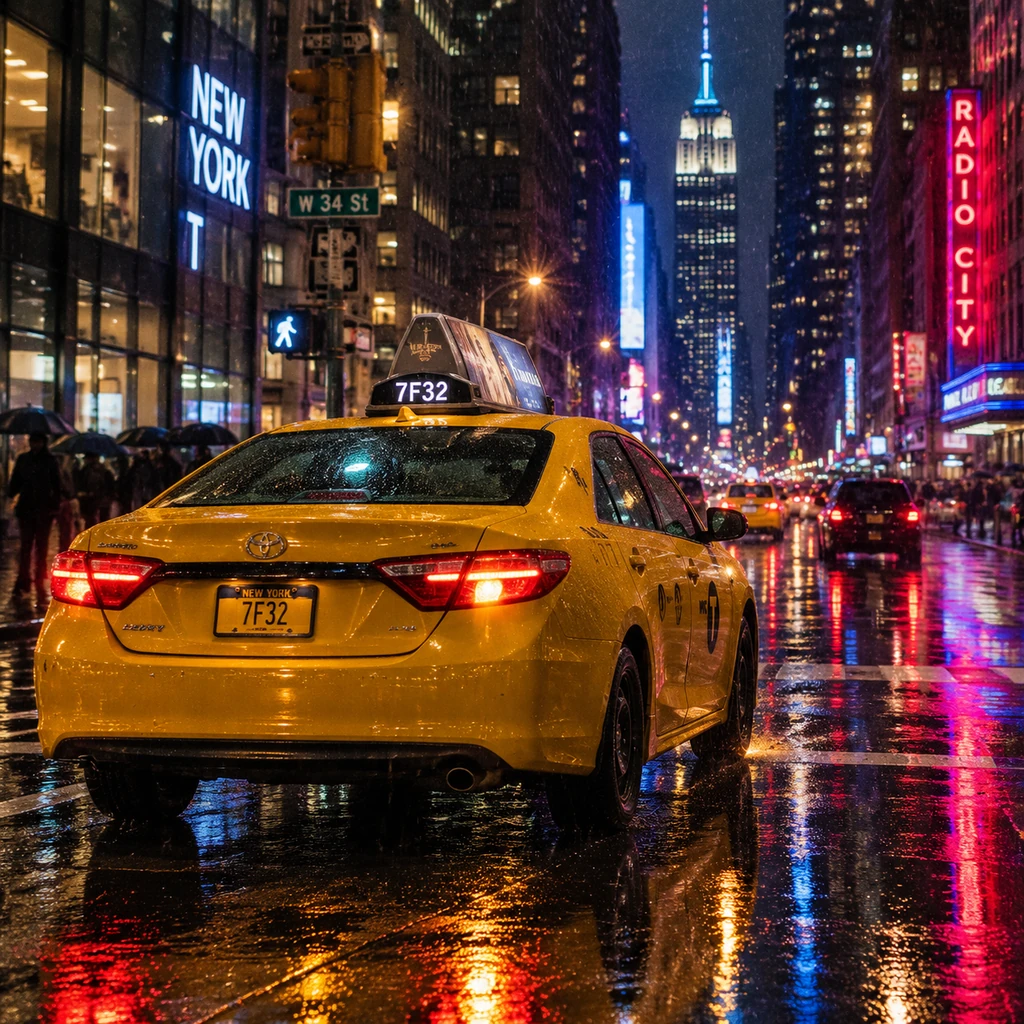
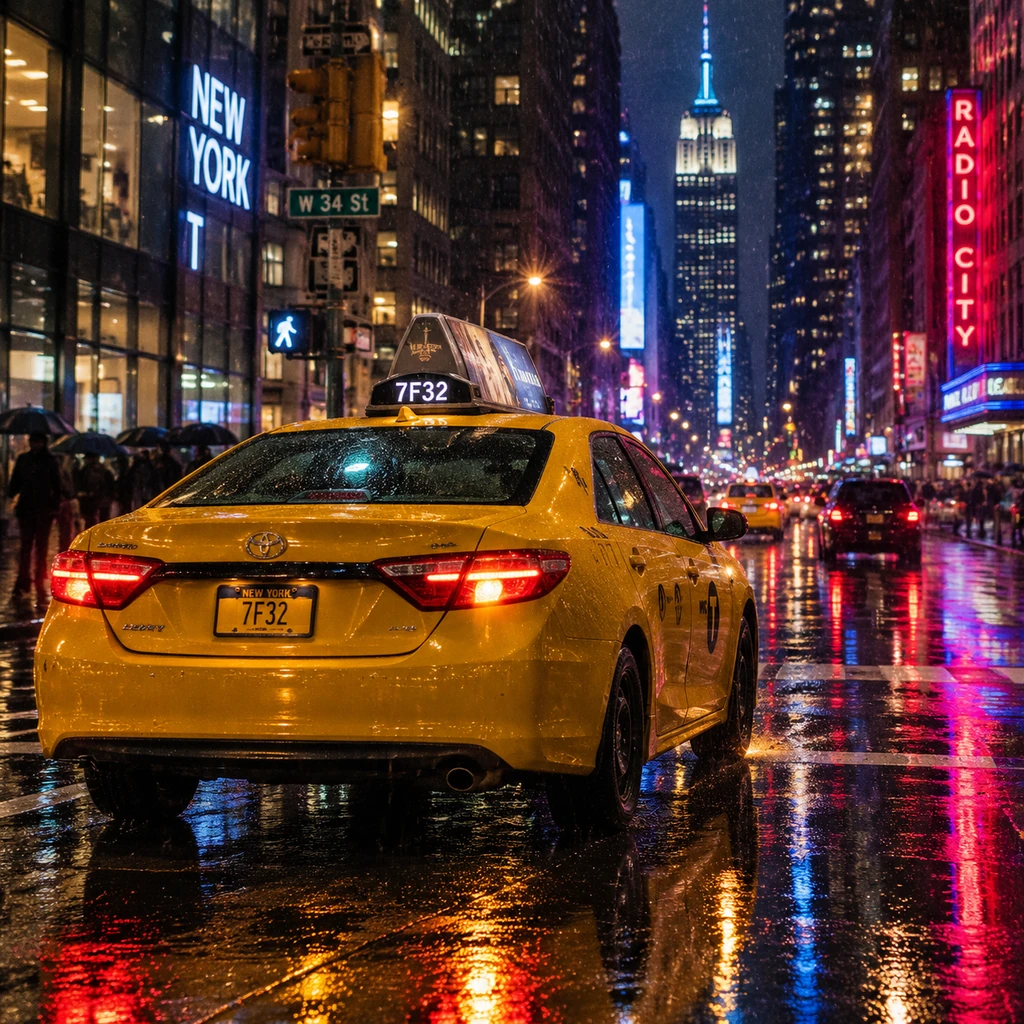
A yellow taxi waits on a wet New York avenue at night while neon signs, traffic lights and a lit skyscraper reflect in red, blue and gold across the rain-soaked road.
What the image shows and why the short prompt works
A yellow taxi with a lit roof sign fills the lower center of the frame, seen from behind at a low angle, its red tail lights glowing. The avenue is soaked with rain, and every light source becomes a long reflection: red and pink neon on the right, blue and white signs on the left, and gold street lamps. Pedestrians with umbrellas stand under a building on the left, more taxis and cars head down the street, and a tall Art Deco tower lit in blue rises at the end of the avenue under a dark, rainy sky. The prompt gives one subject (a yellow taxi), one place (a New York street), the weather and time (rain at night), one visual effect (neon reflections) and the genre (photorealistic). Rain plus neon is a strong pairing because wet asphalt turns every light into a reflection, so the scene looks rich without listing colors or props. Naming the city lets the model add recognizable signage and skyline on its own.
How to adapt the method
Swap the vehicle (a red double-decker bus, a tuk-tuk, a vintage car) and the city (London, Tokyo, Bangkok) and keep the rain, the night and the neon reflections. Ask for a wide aspect ratio in Studio for a desktop wallpaper or 9:16 for a phone background. If you need a scene without real brands or landmarks, say so in the prompt. Owner-supplied prompt: the exact text used for this output, unchanged.
How to use this prompt
1
Read the complete prompt alongside the result. Identify the subject, framing, lighting and visual style before changing the brief.
2
Open the selected recipe in Studio with its model and starting settings. Check the available version, frame and resolution before generating; a size written in the source prompt is not an output setting or a guarantee.
3
Use the customization fields below to rewrite the brief: Subject / Delivered dimensions. Keep the composition and other constraints that make this example useful. Check the current credit quote before submitting.
What to check in your result
Compare the result with the chosen example: subject position, light direction and the balance between foreground and background. Inspect hands, faces, product shapes and any text at full size. Change one variable at a time so you can judge what improved.